Grey Skies, Green Tills: Turning Britain's Worst Weather Into Your Café's Best Trading Days

Grey Skies, Green Tills: Turning Britain's Worst Weather Into Your Café's Best Trading Days
There's a particular kind of resignation that settles over a café on a wet Tuesday in February. The rain hammers the window, the pavement outside is empty, and the owner glances at the till with the quiet acceptance of someone who's decided the weather has made the decision for them. It's understandable. It's also a missed opportunity.
Britain's weather is notoriously unpredictable, but it is, in its own way, remarkably consistent. It rains. A lot. Across most of the UK, you can expect significant rainfall on roughly 150 days a year. If your café's trading performance is simply a function of what's happening outside the window, you're handing a substantial portion of your annual revenue to meteorology. The café owners who've stopped doing that are worth paying attention to.
Why Bad Weather Is Actually a Commercial Brief
Here's a reframe worth sitting with: bad weather doesn't just reduce footfall — it also creates a specific emotional state in the people who do venture out. They're cold, damp, possibly a bit fed up. They want warmth, comfort, and something that feels like a small reward for having left the house at all.
That emotional state is one of the most commercially receptive a café customer can be in. The question isn't "how do we survive the rain?" — it's "how do we give people a reason to come in out of it, and make sure they spend well when they do?"
These are design problems, not weather problems. And design problems have solutions.
Engineering a Menu That Earns Its Keep on Grey Days
Seasonal menu engineering is one of the most powerful and underused tools in the independent café's arsenal. Most operators swap their menus seasonally in broad strokes — hot drinks in winter, cold drinks in summer — but fewer think about weather-responsive menu positioning with any real precision.
Consider what performs when the weather turns:
Warming specials with a story. A well-named seasonal drink — something evocative rather than just descriptive — sells itself on a cold day. "Autumn Spice Latte" is fine. "Bonfire Flat White" or "Rainy Day Remedy" invites curiosity and creates a small moment of delight. The name does part of the selling for you.
Comfort food pairings. On wet days, customers are significantly more likely to add food to their order. A visible, well-presented display of toasted items, warming soups, or freshly baked goods near the counter converts browsers into buyers. If your kitchen can produce something that smells good, that's your most powerful marketing tool on a grey afternoon.
Higher-margin hot drinks pushed prominently. Mocha, hot chocolate, chai latte — these tend to carry better margins than standard espresso drinks and are naturally more appealing in poor weather. Positioning them at eye level on your menu board, rather than buried in a list, can measurably shift your average spend.
The Social Media Window: Posting When It Pours
Most café social media strategies follow a predictable pattern: post the beautiful latte art, the sunny terrace, the aesthetically pleasing flat lay. These perform well on good days. On rainy days, they feel disconnected from the actual experience of being outside.
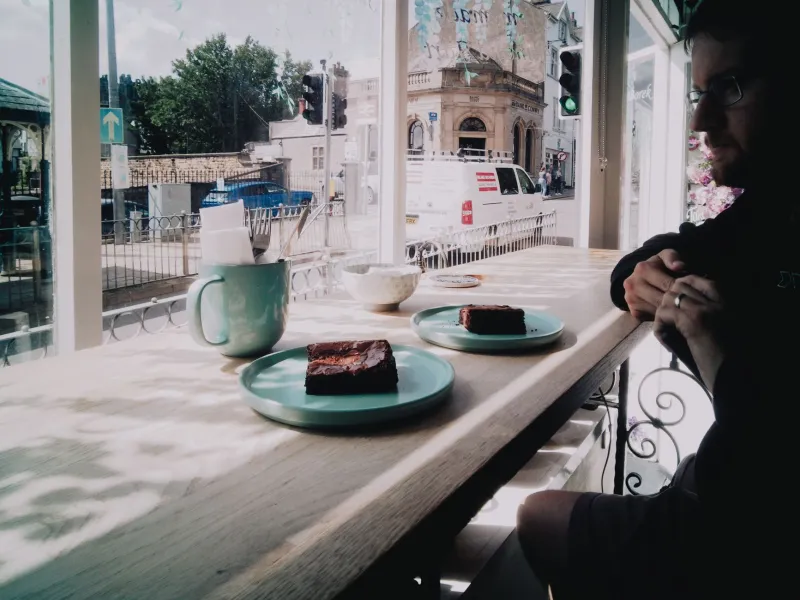
Some of the most effective café social content in poor weather is also the most straightforward: a photo of steamed-up windows and a warm drink, posted in real time, with a caption that essentially says "you know where we are." It's not sophisticated, but it's emotionally resonant in a way that polished content often isn't.
A few tactics that work without requiring a marketing budget:
-
Real-time rain posts. Post when the weather turns. Tag your location. Keep it warm and conversational. "It's absolutely tipping it down out there — just saying, we've got [drink name] on today and the heating is very much on." That kind of post, delivered at the right moment, has genuine pull.
-
Rain-day offers with a short window. A time-limited promotion — "free biscuit with any hot drink until 3pm today" — creates urgency without devaluing your product. It also gives people a reason to share the post, which extends your reach organically.
-
Stories over feed posts. Instagram and Facebook Stories disappear within 24 hours, which makes them feel current and immediate in a way that feed posts don't. Weather-reactive content belongs in Stories.
Indoor Events: Programming Your Space When Outside Is Uninviting
A café that becomes a destination in its own right — rather than simply a place to buy coffee — is fundamentally more resilient to weather variation. Indoor events don't need to be elaborate or expensive to achieve this.
Consider what works in the context of a café space:
Quiet mornings and work-friendly sessions. Many remote workers actively prefer to work from cafés on grey days when their home feels particularly uninspiring. A "laptop morning" with reliable Wi-Fi, a clear table policy, and a good filter coffee deal positions your café as a productive sanctuary. The spend per head may be modest, but the covers and dwell time add up.
Book clubs, craft sessions, and low-key workshops. These work best in quieter trading periods — weekday evenings, Sunday afternoons in winter — and they serve a dual purpose: they fill a space that would otherwise be empty, and they build the kind of community attachment that creates loyal regulars. A monthly craft evening or a local author reading costs you almost nothing to host and returns disproportionate goodwill.
Tasting events. Coffee tastings, seasonal menu launches, or even informal "meet the roaster" evenings are natural fits for a café and create genuine excitement around your product. These work particularly well on the kind of grey autumn or winter evenings when people are looking for a reason to go out.
Rain-Day Loyalty: Rewarding the Brave Ones
There's a simple loyalty mechanic that several café owners have used effectively: double stamps or points on wet days. The mechanics are straightforward — if you use a digital loyalty programme, you can activate the offer with a single setting change. If you use stamp cards, a member of staff can apply a small sticker indicating the promotion.
The effect is twofold. Existing loyal customers feel rewarded for making the effort to come in, which reinforces the habit. And the offer, when posted on social media, gives occasional customers a nudge to make the trip they might not otherwise have bothered with.
Accepting What You Can't Control, Designing What You Can
None of this eliminates the commercial reality that footfall is lower on poor weather days. Some of that drop is simply unavoidable — people who were planning a leisurely stroll past your café won't be making that stroll, and no amount of Instagram posting will change that.
But the difference between a café that passively accepts the weather's verdict and one that actively designs around it is measurable. The tactics above won't turn a rainy Tuesday into a Bank Holiday Saturday. They will, over time, shrink the revenue gap between your best days and your worst — and in a business where margins are tight and consistency matters, that's worth quite a lot.