Longer Stays, Larger Spends: What Retail Giants Know About Café Space That Independent Owners Don't
Longer Stays, Larger Spends: What Retail Giants Know About Café Space That Independent Owners Don't
Let's talk about IKEA for a moment. Not the flat-pack furniture, the meatballs, or the labyrinthine store layout — though all of those are relevant — but the café. Because the IKEA restaurant isn't an afterthought. It isn't there to keep hungry shoppers fuelled so they can get back to browsing. It's a deliberate, meticulously engineered commercial instrument, designed to increase dwell time, soften the friction of a big-ticket purchase decision, and create the kind of emotional warmth that makes you feel good about spending money.
John Lewis has understood this for decades. So has Waitrose, Marks & Spencer, and practically every major UK supermarket chain that has rolled out in-store café concessions. These businesses didn't add coffee because they like coffee. They added it because the data told them something powerful: customers who sit down, slow down, and feel comfortable spend more. They return more often. And they associate the positive emotional experience of that moment — the warmth, the smell, the brief respite from the world — with the brand that provided it.
 Photo: John Lewis, via americanassociationoficonographers.com
Independent café owners, meanwhile, tend to think about their space in terms of aesthetics. Does it look good? Is it Instagrammable? Does the colour palette feel on-trend? These aren't irrelevant questions, but they're the wrong starting point. The smarter question — the one the retail giants ask first — is: how does this space make people behave?
Dwell Time Is a Revenue Metric, Not a Hospitality Nicety
Before getting into specifics, it's worth establishing a foundational principle: dwell time and spend are not loosely correlated. They are directly and measurably linked.
Research from the hospitality sector consistently shows that customers who stay longer spend more — not just proportionally, but disproportionately. The second drink, the slice of cake, the decision to try the toastie rather than just a coffee: these don't happen in the first ten minutes of a visit. They happen when someone has settled in, feels at ease, and starts to think of your space as somewhere they want to be rather than somewhere they've briefly stopped.
IKEA's café placement — smack in the middle of the store journey, offering genuinely affordable food and plenty of comfortable seating — isn't generosity. It's a calculated pause button. Get someone to sit down for twenty minutes, and the probability of them completing a larger purchase goes up significantly. The same principle applies in your café, even if you're not selling wardrobes.
The Layout Lever You're Probably Pulling Wrong
Most independent café owners arrange their seating to maximise covers — the instinct to fit in as many tables as possible is understandable when you're paying London-level commercial rent. But maximum covers and maximum revenue aren't the same thing, and conflating them is one of the more common and costly mistakes in café design.
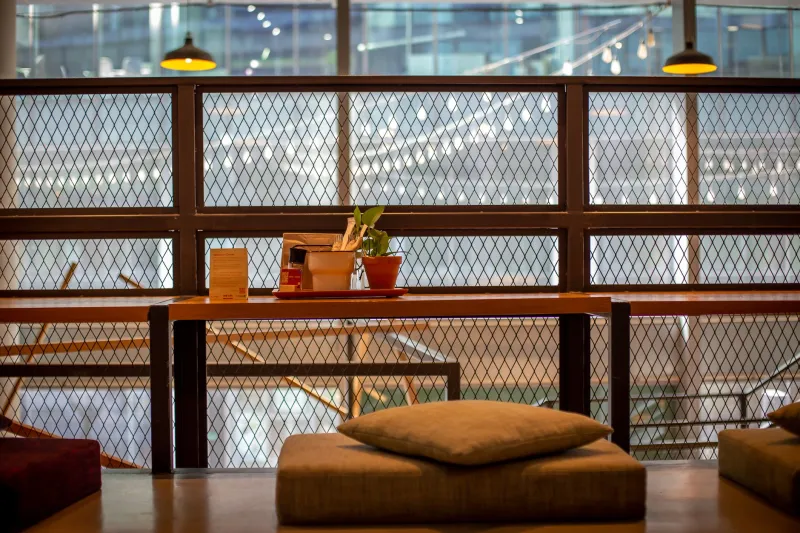
Tightly packed seating creates a sense of exposure that shortens visits. People feel watched, crowded, and self-conscious. They drink up and leave. Conversely, spaces that offer a mix of seating types — a few larger communal tables, some intimate two-person spots, a window bench, a couple of armchairs if you have the room — give customers the ability to self-select an environment that matches their mood. Someone working on a laptop needs a different configuration from a pair of friends catching up. A mother with a toddler needs something different again.
John Lewis café spaces, almost without exception, offer this kind of seating variety. It's not accidental, and it's not about interior design awards. It's about giving every type of customer a reason to stay.
Sound, Light, and the Sensory Architecture of Spending
This is where it gets genuinely interesting — and where independent owners have the most untapped potential.
Decades of research in consumer psychology have established that sensory environment has a measurable effect on spending behaviour. Music tempo is one of the most well-documented variables: slower background music has been shown to increase dwell time and average spend in food service settings. Not silent — silence creates its own discomfort — but unhurried. The playlist in your café is a commercial decision, not just a vibe choice.
Lighting works similarly. Bright, cool lighting signals efficiency and speed — think McDonald's. Warmer, lower lighting encourages people to relax and stay. If your café currently feels more like a well-lit office than a comfortable retreat, your lighting scheme may be actively shortening your customers' visits.
Scent is the most primal lever of all. The smell of freshly ground coffee is one of the most powerful commercial scents in existence — it triggers appetite, pleasure, and a sense of welcome simultaneously. Supermarket bakery sections have exploited this for years by positioning ovens near entrances. Your grinder is doing the same work, but only if it's positioned where the aroma reaches customers as they walk in, not tucked away behind a counter partition.
The Table-Clearing Paradox
Here's a counterintuitive one that the big operators have figured out: clearing tables too quickly is bad for revenue.
The instinct to keep a café looking clean and tidy is understandable — no one wants to sit next to a pile of abandoned cups. But there's a meaningful difference between clearing a genuinely empty table and hovering over a customer the moment they finish their first drink. The latter signals, loudly and without any words, that their time is up and they should be moving on.
Waitrose café staff are trained to be present without being intrusive. The difference is subtle but commercially significant. A customer who feels gently watched and hurried will leave. A customer who feels comfortable and unhurried will order again.
The practical application for independents: train your team to read the table, not the cup. An empty cup on a table where someone is mid-conversation or mid-laptop session is not a cue to clear. It's a cue to approach warmly and ask if they'd like anything else. That's not a sales script — it's just good hospitality. And it's the moment where the second drink gets ordered.
Borrowing Big-Brand Thinking on a Small-Business Budget
None of this requires a corporate budget or a design agency. The changes that move the needle — adjusting your seating mix, rethinking your playlist, reviewing your lighting temperature, repositioning your grinder, and coaching your team on table-reading — cost very little and can be implemented this week.
What they do require is a shift in perspective: from thinking about your café as a place that looks good to thinking about it as a space engineered for behaviour. The retail giants didn't build their café strategies on aesthetics. They built them on data, psychology, and a clear-eyed understanding that how long someone stays is the single most controllable variable in how much they spend.
Your space is already doing something to your customers. The question is whether you've decided what that something should be.