The Talent Drought: Why Finding Great Baristas Is Getting Harder and What Independent Cafés Can Do About It
Ask any independent café owner what keeps them up at night and staffing will be near the top of the list. Not just finding people — finding people who actually know what they're doing behind an espresso machine. The gap between a competent barista and a genuinely skilled one is enormous, and in a sector where the quality of your coffee is your primary competitive differentiator, that gap has real commercial consequences.
What's less discussed is why this gap exists and why it seems to be widening. Wages and working conditions get most of the airtime, and they matter — but they're not the whole story. Britain simply lacks the kind of structured vocational pathways that exist in other skilled trades, and coffee has been particularly poorly served by the education and training system. The result is an industry that largely teaches itself, often inconsistently, and then wonders why quality and retention are problems.
A Skills Pipeline That Was Never Really Built
In countries like Australia and parts of Europe, barista craft occupies a recognised place in hospitality education. College programmes include coffee modules with real depth. Employers have a clearer sense of what a qualified candidate looks like. In the UK, the picture is patchier.
SCA (Specialty Coffee Association) qualifications exist and are genuinely valuable, but they're self-funded, relatively expensive for individuals at entry level, and not embedded in mainstream education in any meaningful way. Most people entering café work in Britain learn on the job, to whatever standard their employer happens to maintain — which varies wildly.
The consequence for independent café owners is that the hiring pool is heavily skewed. You'll receive applications from people with varying levels of experience, and distinguishing genuine skill from confident self-presentation in a short interview is genuinely difficult. Many owners have hired someone who claimed barista experience and discovered, on day one, that their definition of that experience and the candidate's were quite different.
What This Is Actually Costing You
The financial impact of the skills shortage is diffuse but real. Consider:
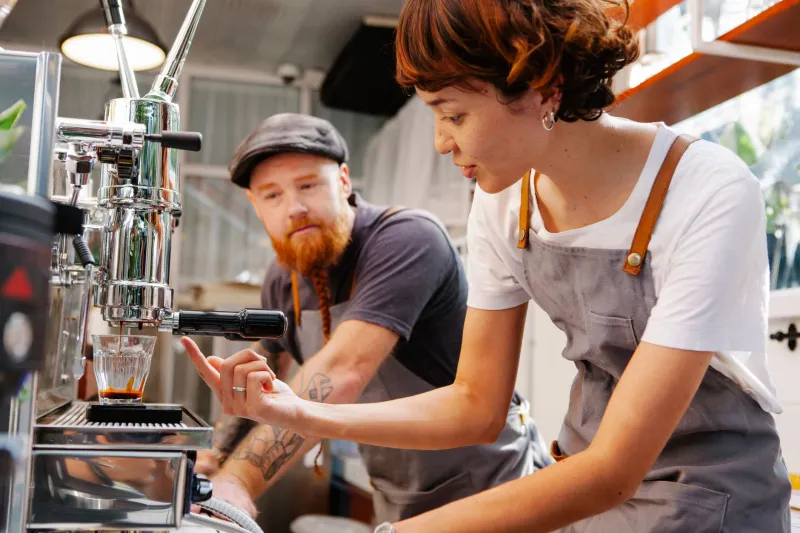
Higher training investment per hire. If most new starters need significant upskilling before they can work unsupported on the machine, your senior staff — who are already stretched — are absorbing that training burden. That's time away from service quality and customer experience.
Inconsistent product quality. Customers notice when their flat white tastes different depending on who's working. In a competitive high street environment, inconsistency erodes loyalty faster than most café owners realise.
Retention problems. Staff who don't feel they're developing professionally leave. The cafés that invest in genuine skill development tend to hold onto people longer — which has its own significant financial value when you account for the real cost of recruitment and onboarding.
Wage inflation without productivity gain. When skilled baristas are scarce, those who have demonstrable ability command higher wages. That's entirely fair, but it means the cost of quality is rising even as the supply of quality isn't keeping pace.
The In-House Apprenticeship Model
Some of the most interesting responses to this problem are coming from independent café owners who've stopped waiting for the pipeline to improve and started building their own.
The approach varies, but the principle is consistent: identify people with genuine potential — enthusiasm, customer empathy, attention to detail — and invest in developing them properly rather than hoping to hire fully formed. This means structured training programmes, clear progression milestones, and genuine investment in SCA or equivalent qualifications as part of the employment offer.
It costs money upfront. A foundation-level SCA barista qualification runs around £200 to £300 per person when delivered externally. Some café owners are developing relationships with local colleges and training providers to deliver this more cost-effectively, or to bring elements of the training in-house once senior staff have the credentials to deliver it.
The return on that investment shows up in retention, in service quality, and — perhaps most valuably — in the culture it creates. When staff see that their employer takes their development seriously, the relationship changes. Barista craft stops being a stopgap job and starts feeling like a genuine career path. That shift in perception is worth considerably more than the cost of a qualification.
College Partnerships: An Underused Route
Several UK further education colleges now run hospitality programmes that include coffee elements, and some are actively looking for employer partners to provide placements and practical experience. For independent café owners, these relationships offer a route to engaged, motivated young people who are actively investing in the industry — often before they've developed the bad habits that come with patchy on-the-job learning.
Building these relationships takes time and a degree of patience with the rhythms of the education system, but the café owners who've done it describe it as one of the better talent pipeline decisions they've made. You're not just accessing candidates — you're shaping what those candidates learn and how they think about coffee before they enter the workforce.
What Happens If the Industry Doesn't Act
The honest answer is that the skills gap will continue to widen, and the cafés best positioned to weather that will be the ones that have built internal development capacity rather than relying on the external market to supply them with ready-made talent.
For the broader industry, the stakes are higher. Britain's specialty coffee scene has built a genuinely impressive reputation over the past decade. That reputation rests on the quality of the people making the coffee. If barista craft continues to be treated as a casual, entry-level role rather than a genuine profession with a real career structure, the talent base that underpins that reputation will erode.
For individual café owners, the message is more immediate: the businesses that treat staff development as a core operational priority — not a nice-to-have — will find it meaningfully easier to hire, retain, and deliver consistent quality over the next five years. That's not a soft HR argument. It's a straightforward commercial one.