Why Do Some Cafés Always Get Asked for Another Round? The Psychology of the Second Drink
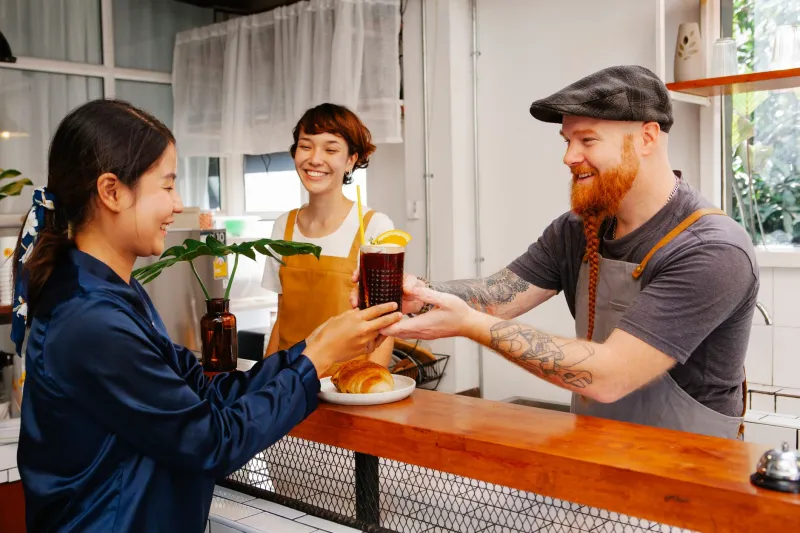
There's a moment that happens in every café, dozens of times a day, that most owners barely register. A customer finishes their drink, sets the cup down, and pauses. In that pause — which lasts perhaps three to five seconds — a decision is being made. Stay and order again, or go? The outcome of that micro-moment, multiplied across every customer every day, is one of the most significant financial variables in your entire business.
And yet most café owners have never deliberately thought about how to influence it.
The second drink — the refill, the extra flat white, the herbal tea ordered while a friend catches up — isn't a happy accident. In the cafés that sell them consistently, it's the product of a carefully (if not always consciously) constructed environment and a set of staff behaviours that make re-ordering feel natural, easy, and welcome. In the cafés that rarely get asked, something in the experience — often multiple things — is quietly but firmly closing the door on that possibility.
Let's open it back up.
The Cup Size Trap
Start with something physical: the vessel your coffee arrives in.
Research in consumer psychology has repeatedly demonstrated that people gauge satisfaction and completion by how a container looks relative to its contents. A small, thick-walled ceramic cup that's filled to the brim creates a strong psychological signal of completeness when drained. A large, thin-walled mug that's half-full creates the opposite — a lingering sense of insufficiency that actually suppresses the desire for more, because the customer never felt fully satisfied by the first drink.
This sounds paradoxical, but it's well-established. The sweet spot for second-drink behaviour is a cup that feels generous and satisfying but doesn't create the post-drink torpor of an oversized portion. The classic 8oz flat white served in a properly proportioned ceramic cup consistently outperforms a 12oz takeaway-style drink when it comes to repeat ordering — because the customer finishes it feeling pleasantly complete rather than overfull, and is naturally open to the idea of something else.
If you've recently shifted to larger cup formats to justify a price point, it's worth testing whether that's actually suppressing your overall transaction value by reducing second-drink orders.
Timing: The Single Most Controllable Variable
Ask any experienced hospitality professional what kills the second drink, and they'll give you the same answer within seconds: clearing the table too early, or failing to check in at the right moment.
The window for a second drink order is narrow. It opens as a customer finishes their first drink and is still engaged — in conversation, in work, in reading — and it closes the moment they start gathering their things. Miss that window, and the sale is gone. Hit it with the right approach, and conversion rates in well-run independent cafés can be remarkably high.
The right approach isn't a script. It's eye contact, a genuine smile, and a simple, open question — "Can I get you anything else?" or even just "Another one?" — delivered at the moment the cup goes down, not three minutes later when the customer has mentally checked out.
What kills this is a combination of under-staffing and poor floor awareness. When your team is head-down at the counter, they're not reading the room. Training staff to periodically scan the floor — not in a hawkish, intrusive way, but with genuine attentiveness — is one of the simplest and highest-return investments you can make in your team's commercial effectiveness.
Music Tempo and the Invisible Accelerator
This one tends to surprise café owners when they first encounter it, but the evidence is solid enough that it's been replicated across multiple decades of hospitality research.
The tempo of background music has a measurable effect on how quickly customers eat, drink, and leave. Faster music — above roughly 94 beats per minute — correlates with faster consumption and shorter visits. Slower music correlates with longer dwell times and, critically, higher average spend per visit.
The mechanism is relatively straightforward: faster music raises physiological arousal slightly, which speeds up perceived time and unconsciously accelerates behaviour. Slower music has the opposite effect — it slows the room down, makes people feel more relaxed, and creates the unhurried atmosphere in which a second drink feels like a natural extension of the visit rather than an indulgence.
This doesn't mean your café should sound like a spa. The character and genre of music matters for brand identity. But the tempo is a lever you can adjust without changing your playlist's personality, and it's one that many UK café owners have never consciously pulled.
A practical test: run your current playlist through a BPM analyser (there are free ones online), calculate the average tempo, and try dropping it by 10–15 BPM for a week. Track your average transaction value. The results may well surprise you.
The Environmental Cues That Say "Stay" or "Go"
Beyond music, there's a broader set of environmental signals that communicate to customers — entirely beneath conscious awareness — whether they're welcome to linger or expected to move on.
Lighting temperature is one. As discussed elsewhere, warmer light encourages longer stays. But there's also the subtler question of sight lines and the feeling of being watched. Seating that faces a wall or a window gives customers a sense of privacy and enclosure that promotes relaxation. Seating that faces directly into the service area — where they're in the eyeline of staff and other customers — creates low-level social discomfort that shortens visits.
Table clearance timing is another signal. A team that swoops in to clear the moment a cup is empty is communicating, unintentionally but unmistakably, that the customer's time is up. Leaving a cup on the table for a beat longer — while being attentive and warm — keeps the visit feeling open and unresolved, which is actually the psychological state most conducive to ordering again.
None of this is manipulation. It's simply creating an environment where the natural human desire to sit, relax, and enjoy another good coffee isn't being inadvertently suppressed by the space around it.
The Maths of Marginal Gains
Let's put some numbers around this, because the financial case for focusing on second drinks is compelling.
If your café serves 80 customers on an average weekday and your average transaction value is £4.20, that's £336 in daily revenue. If environmental and service changes increase the proportion of customers ordering a second drink from, say, 12% to 22% — a shift that is entirely achievable through the changes described above — you're adding roughly 8 additional drinks at an average of £3.50. That's £28 per day, or around £7,000 per year, from a set of adjustments that cost almost nothing to implement.
The second drink is the most undervalued revenue opportunity in the independent café sector. It requires no new product development, no marketing spend, and no price increases. It just requires understanding the quiet, invisible forces that make customers want to stay — and then deliberately, thoughtfully, creating more of them.